
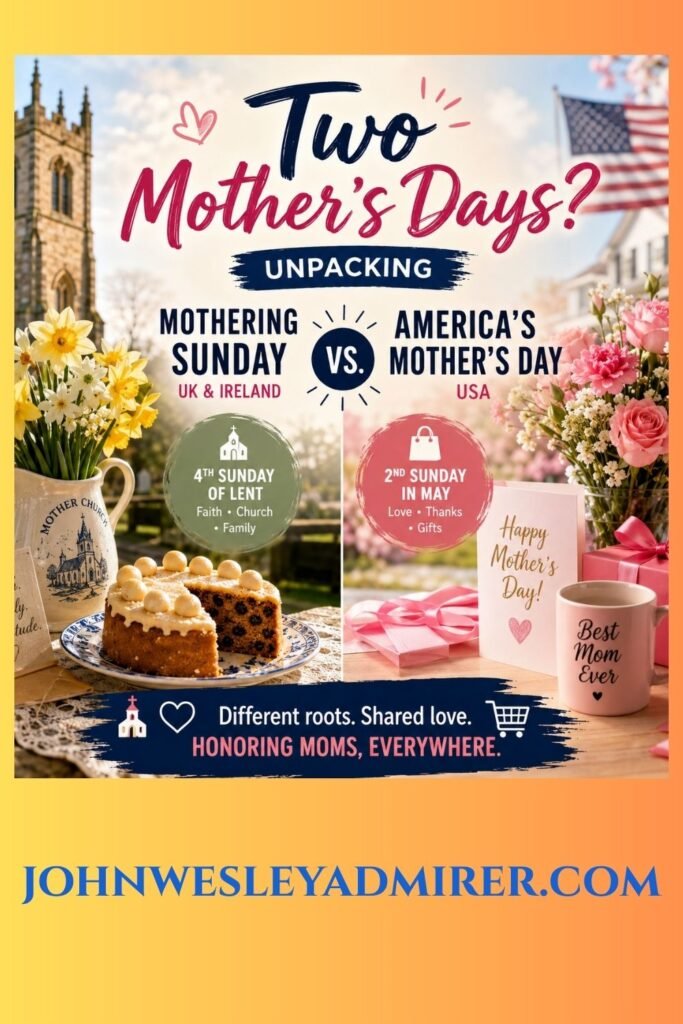
Why is Mother’s Day always on a Sunday in the United States of America (USA)? In the United Kingdom (UK) and Ireland it isn’t in May at all, but on the fourth Sunday of Lent – a day historically known as Mothering Sunday.
In contrast, the American-style Mother’s Day was first celebrated in 1908 and officially proclaimed by President Woodrow Wilson in 1914. This article unravels the separate origins and traditions behind these two holidays.
Mothering Sunday and the United States (U.S) Mother’s Day are related but distinct traditions. Mothering Sunday in the UK dates to at least the 16th century (and possibly earlier medieval practices of returning to the “Mother church” on Laetare Sunday and was revived in the early 20th century by Constance Penswick Smith to emphasize both the church and maternal care.
By contrast, America’s Mother’s Day was launched in 1908 by social activist Anna Jarvis (inspired by her mother’s wish) and made a national holiday by President Woodrow Wilson in 1914.
Mothering Sunday remains tied to the 4th Sunday of Lent (March/April) and retains some religious overtones (church services, Bible readings, and traditional foods like simnel cake.
American Mother’s Day is fixed on the second Sunday in May and has become overwhelmingly secular and commercial, marked by cards, flowers, brunches, and gift‑giving.
Both holidays now feature wide geographic spread (UK/Commonwealth vs global observance of Mother’s Day) and have sparked cultural debates over commercialization and inclusivity.
The table below summarizes the contrasts, and the timelines highlight key developments in each tradition.
| Feature | Mothering Sunday (UK) | Mother’s Day (USA) |
| Origin | Medieval church practice of visiting one’s “mother church” on Laetare Sunday. | Early 20th-c. social commemoration inspired by Anna Jarvis’s campaign for mothers. |
| Founder/Initiator | Constance Adelaide “Penswick” Smith (revived tradition, 1913–1920s). | Ann Reeves Jarvis (concept of a mothers’ work clubs) and her daughter Anna Jarvis (first observance 1908). |
| Date(s) | 4th Sunday of Lent (movable – typically Mar/Apr). | 2nd Sunday of May each year. |
| Religious vs Secular | Originally religious (church/baptismal roots, Virgin Mary); now semi-religious emphasis on “Mother Church” and thanksgiving. | Primarily secular (civil holiday honoring motherhood); roots in church services but now a commercial/generic observance. |
| Typical Customs | Attending church, giving flowers (daffodils often) and simnel cake, family gatherings. Church communities may give thanks for all “mothering” roles. | Sending cards and flowers, brunch/dinner for mothers, giving gifts. Churches often honor mothers, but most focus is on gifting (flowers, cards, outings). |
| Commercialization | Low-to-moderate. Historically modest (home-baked gifts, flowers); some modern card/flower marketing in UK but far less than US. Mothers’ Union and Church caution against commercial pressure. | Very high. Hallmark and retailers vigorously promote it (2nd-largest card/gift holiday in US). Anna Jarvis famously fought commercialization, but today spending (~$38B in 2026) dwarfs its religious observance. |
| Geographic Prevalence | UK (England, Scotland, Ireland) and some Commonwealth churches. Also celebrated as “Mothering Sunday” in parts of Europe and former British territories. Generally, falls in Mar/Apr. | United States (since 1914 national holiday) and many countries (Canada, Australia, Japan, most of Europe) now observe a “Mother’s Day” on 2nd Sunday May. (Some countries use other dates – e.g. France last Sun May, Mexico May 10 fixed.) |
Hypothetical split of celebration focus (commercial vs. religious) on Mother’s Day in the US vs Mothering Sunday in the UK. In the U.S., commercial gift‐giving dominates (e.g. 84% of adults celebrate with flowers/cards, whereas in the UK a larger fraction of observance may include church or “thanksgiving” elements. (Based on NRF/ParcelHero data.)
Historical Origins and Evolution
Mothering Sunday (UK): The roots of Mothering Sunday lie in medieval Christianity. By at least the 16th century, the fourth Sunday of Lent (Laetare Sunday) was a special “Refreshment” break in Lent when people would return to their mother church (the church of baptism).
Over time it also became a family day: servants and apprentices were given the day off each year to go see their mothers and families, bringing simnel cake and flowers (an early form of gift). Poet Robert Herrick (1648) even mentions bringing a “Simnel” cake for Mothering Sunday.
These traditions faded by the late 19th century until a revival movement led by Constance Adelaide Penswick Smith (1898–1938) in the 1910s reclaimed Mothering Sunday. Influenced by the American Mother’s Day, Smith wrote In Praise of Mother: A Story of Mothering Sunday (1913) and formed a society to promote the day. By her death in 1938 it was celebrated in virtually every Church of England parish and across the Empire.
A British Library history notes the holiday’s medieval origin: “Jerusalem… was our mother” in Galatians was the lectionary theme on Laetare Sunday. Until WWII it remained a purely church-and-family tradition. (During WWII, American servicemen in Britain brought wider commercial influences, but Mothering Sunday in the UK steadfastly remained on its mid‐Lent Sunday, not copied to May).
Mother’s Day (USA): In the United States, an earlier secularized “Mother’s Day” was proposed by Julia Ward Howe in 1872 as a Mother’s Day for Peace (celebrated in June). However, the modern American Mother’s Day stems from Anna M. Jarvis of Pennsylvania. After her mother’s death in 1905, Anna Jarvis began organizing a memorial service in May 1908 (in Grafton, WV and Philadelphia) to honor individual mothers.
Jarvis campaigned widely: by 1911 many U.S. states held Mother’s Day events (with whites carnations and church services). In 1914 Congress passed a resolution (May 8, 1914) and President Woodrow Wilson proclaimed the second Sunday of May as Mother’s Day. The official proclamation called for flags and public ceremonies as “A public expression of our love and reverence for the mothers of our country.”
Jarvis then formed the Mother’s Day International Association (1912) to oversee observance, but quickly became disillusioned as greeting cards and retailers co-opted the holiday. Over the 20th century U.S. Mother’s Day shifted from Jarvis’s church-based vision to a mass-consumer event.
Geographic Spread and Contemporary Dates
Mothering Sunday remains chiefly a British and Irish observance (and in Anglican churches worldwide), held each year on the 4th Sunday of Lent (mid-March or early April, variable). For example, in 2026 Mothering Sunday was on March 11. Notably, it is never on a fixed date: it “Moves” with the liturgical calendar.
By contrast, America’s Mother’s Day is always on the second Sunday in May (so in 2026 it is on May 10), set by the 1914 resolution. Many countries have since adopted the May date; Canada, Australia, Japan and much of Europe celebrate on the same day as the U.S. (or close to it), while a few have other traditions (France’s Fête des Mères is on the last Sunday of May, Mexico on May 10 each year, etc.).
Observances and Rituals
On Mothering Sunday in the UK, many families and churches blend secular and sacred elements. Historically, people attended the mother church for a special service. Today congregations often present flowers (especially daffodils or carnations) to all women in the pews. Typical gifts include homemade cakes or a simnel cake (a fruit-and-marzipan cake with eleven marzipan balls), and children traditionally take breakfast or dinner to their mothers. The Mothers’ Union and churches encourage an inclusive “Mothering” focus – honoring not just biological mothers but any caregivers or mother-figures.
On U.S. Mother’s Day, by contrast, the rituals are largely secular. Common customs include giving greeting cards, flowers (especially carnations or roses), chocolates, and going out for a special meal or outing. Church attendance often spikes (many parishes have special Mother’s Day prayers or ask all mothers to stand), but attending church is not required by the holiday.
According to NRF surveys, typical American Mother’s Day plans are: 75–84% buying flowers, ~74% buying cards, and over 60% planning brunch or dinner out. By comparison, UK surveys find 72% send a card and 68% buy flowers. (A 2025 YouGov UK poll similarly showed flowers as the top gift (34%) and chocolates second (22%).
Commercialization and Media Influence: Commercialism is a major point of divergence. In the UK, Mothering Sunday has some greeting-card and florist marketing (even UK retailers advertise Mother’s Day sales in March), but it remains modest. Church organizations openly resist materialism: the Mothers’ Union warns against commercial pressure and encourages charitable “fair trade” gifts.
In the U.S., however, Mother’s Day is one of the biggest commercial holidays. According to the National Retail Federation, Americans were expected to spend a record $38 billion in 2026 on Mother’s Day gifts (up from $34.1B in 2024. Flowers (75%) and greeting cards (74%) are the most-purchased items. Hallmark calls it the third-largest card-sending holiday (about 113 million U.S. cards exchanged annually). Social media and ads heavily promote pastel-themed images of idealized motherhood, which critics say reinforce stereotypes.
Anna Jarvis herself famously became a critic of this commercialization. She warned against the “Hallmark holiday” aspect, prescribing instead a single white carnation and hand-written notes. As late as the 1940s Jarvis campaigned to abolish Mother’s Day, but the card and candy industry had already cemented it. Even in Britain the Guardian notes, today Mothering Sunday is often conflated with Mother’s Day’s commercial trappings, though church leaders try to “Give thanks… beyond gifts.”
Cultural Meanings, Critiques, and Inclusivity
Both holidays carry powerful emotional meaning, but they have also drawn criticism. Early feminist activists like Julia Ward Howe envisaged a Mother’s Day as a collective day of social action and peace, not limited to domestic motherhood. Anna Jarvis’s own intent was to honor individual mothers’ service, but opponents (especially anti-suffragists and retailers) soon focused on mothers’ traditional home role.
Modern critics argue that Mother’s Day/Mothering Sunday can idealize motherhood or exclude those without children. The Guardian commentary calls current marketing “Saccharine” and notes it often shows only young, heterosexual, maternal “Angel of the Home” images, reinforcing dated gender norms.
Conversely, proponents highlight that these days provide a socially accepted way to honor women’s work (paid and unpaid) and to celebrate families. Many churches have consciously reframed Mothering Sunday to include step-mothers, foster mothers, single mothers, those who mother in other ways, and even to recognize male caregivers. For example, some liturgies address “all who show motherly care”.
In short, Mothering Sunday and Mother’s Day embody overlapping values of gratitude and family, yet the UK version retains a liturgical heritage while the U.S. version became a massive secular festival.
Conclusion
In summary, Mothering Sunday and Mother’s Day share a theme of honoring maternal care but arose in different contexts. Mothering Sunday is deeply rooted in Christian liturgy and was purposefully revived to include spiritual and communal dimensions.
America’s Mother’s Day, however, was initiated as a civic holiday in the 20th century and has evolved into a highly commercialized cultural festivity. Both continue to adapt — churches today often encourage more inclusive, gratitude-focused celebrations, even as retailers push the gift economy. Scholars note that historical records (e.g. Anna Jarvis’s archives and contemporary church accounts) leave some gaps and debates: for instance, the precise timeline of medieval customs is murky, and the impact of World Wars on each holiday’s prominence is still studied.
Takeaway: Mothering Sunday is essentially the UK’s traditional “Mother church” holiday, superimposed with family celebration, whereas America’s Mother’s Day is a modern commemorative holiday that quickly became a national retail event. Understanding both illuminates how culture, religion, and commerce shape even the simplest family traditions.
Further Reading: For primary and scholarly sources, see the Church of England archives (Church House Publishing) and the Anne Jarvis Papers at West Virginia University. The British Library article on Mothering Sunday and Anna Jarvis biographies (e.g. Britannica provide good historical overviews. The U.S. Congressional and Presidential archives (e.g. Wilson’s 1914 proclamation and the House History highlights) offer official context. Reputable media features (The Guardian commentary, Christian Today and retail reports document modern practices and debates.
Happy Mother’s Day
Disclaimer: This article is provided for general informational and educational purposes only. It reflects a comparative historical and cultural discussion of Mothering Sunday and America’s Mother’s Day and should not be taken as legal, religious, or professional advice.
While every effort has been made to present the information accurately and respectfully, readers are encouraged to verify details through reliable sources, as traditions and interpretations may vary by region, denomination, and context.